
The Music Catalog Tree: How to Build and Manage Your Music Catalog
Most independent musicians spend a lot of time thinking about their next release.
What song should we release? When should we release it? Should it be a single, EP, or album? How do we promote it?
All important questions.
But there is another question that doesn't get nearly enough attention:
👉What happens to that song after the release is over?
This is where I think musicians need to start looking at their music differently.
📢Instead of thinking about every release as a separate project, think about your entire body of music as something you are building over time.
⚡Think of it as a tree.
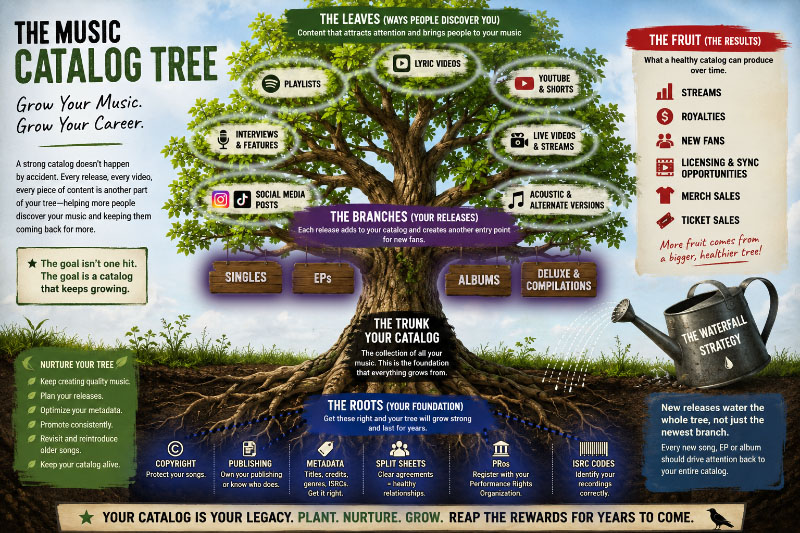
Your music catalog is the tree.
Every new release can grow another branch, but your job is to keep nurturing the whole tree—not abandon the older branches when something new comes along.
Why Your Music Catalog Matters
For many independent musicians, releasing a song feels like reaching the finish line.
You write it, record it, mix it, master it, create the artwork, distribute it, promote it...
Then you move on to the next song.
But your previous release hasn't disappeared.
It is still part of your music catalog.
It can still be discovered, streamed, added to playlists, used in videos, licensed, or introduce a new listener to the rest of your music.
⚡A release doesn't have to be the end of a project. It can become another doorway into your catalog.
The Music Catalog Tree
Here's the way I like to visualize it.
The Roots — Your Foundation
The roots are the things your audience doesn't see, but everything else depends on them.
They include things such as:
- Copyright
- Music publishing
- Songwriter information
- Split sheets
- Metadata
- ISRCs
- Rights and registrations
Strong roots give your music catalog a solid foundation.
We'll dig into these in Part 2.
The Trunk — Your Catalog
⚡The trunk represents your music catalog—the body of work you build over time.
It can include:
- Singles
- EPs
- Albums
- Live recordings
- Remixes
- Acoustic versions
- Reissues
The important thing is that you aren't starting over with every new release.
👉You are adding to something you already own and manage.
The Branches — Your Releases
The branches represent the different releases that grow from your catalog.
A single might become part of an EP. An EP might lead to an album. An older song might later become an acoustic version, remix, or reissue.
Your new release doesn't have to replace the old one.
🔥It can give people another reason to discover it.
The Leaves — How People Discover Your Music
The leaves represent the many ways listeners can find you:
- Streaming playlists
- YouTube and Shorts
- Social media
- Lyric and live videos
- Music blogs
- Search
- Word of mouth
These are all potential entry points into your catalog.
A listener might discover your newest single, then find an older album, then discover a live version of another song.
👉✅The leaf led them to the tree.
The Water — Your Release Strategy
This is where the waterfall release strategy comes in.
👉Waterfall releasing can be a useful way to keep previous songs connected to new releases and continue directing attention toward your catalog.
But I don't see the waterfall as the tree itself.
📢The waterfall is one way of watering the tree.
We'll look at this in detail later in the series.
The Fruit — What Your Catalog Can Produce
A healthy tree eventually produces fruit.
A healthy music catalog can produce:
- Streaming income
- Publishing royalties
- New fans
- Licensing and sync opportunities
- YouTube revenue
- Merch and ticket sales
- New career opportunities
But you don't grow a tree by staring at the fruit.
You look after the roots, trunk, branches, and leaves.
The same is true of your music catalog.
Your Website Is a Great Example
If you have ever managed a website, you already understand part of this concept.
A website isn't one giant page. It is made up of individual pages.
One page may bring you lots of traffic. Another may bring very little. A third might suddenly become popular years after you published it.
You don't know which page will become someone's doorway into your website.
Your music can work in much the same way.
Your songs are individual entry points into your catalog.
A listener may discover your newest song and then explore music you released five years ago.
That's catalog thinking.
And just as you wouldn't normally delete your useful old articles simply because you published a new one, you shouldn't think of older songs as disposable.
👉✅Keep nurturing the tree.
One Song Can Get Their Attention. A Catalog Can Keep It.
Every musician would love to have a hit. Of course.
But building your entire strategy around one song taking off is risky.
A strong catalog gives you more opportunities.
When someone discovers your newest release, what happens next?
Can they find another song?
An album?
A live recording?
An acoustic version?
A playlist?
The better you manage your catalog, the more opportunities you create for a new listener to become a fan.
📢🔥🔥⚡One song can get someone's attention. A catalog can keep it!!!!
The Music Catalog Tree Series
This article is the big picture. In the following articles, we'll look at each part of the tree in detail.
🌱 Part 2 — The Roots: Building a Strong Foundation for Your Music Catalog
🌳 Part 3 — The Trunk: Why Your Music Catalog Is the Asset
🌿 Part 4 — The Branches: Planning Singles, EPs, Albums and More
🍃 Part 5 — The Leaves: Creating More Ways for Fans to Discover Your Music
💧 Part 6 — Watering the Tree: The Modern Waterfall Release Strategy
🍎 Part 7 — The Fruit: What a Healthy Music Catalog Can Produce
H2: Start Growing Your Music Catalog
You don't need a huge catalog to start thinking this way.
You don't need millions of streams or a record deal.
You simply need to stop thinking of each release as something that ends when the next release begins.
👉🔥Every new release can grow another branch.
Your job is to keep nurturing the whole tree.
And most importantly:
✅Don't forget to water it.