
The Roots: Building a Strong Foundation for Your Music Catalog
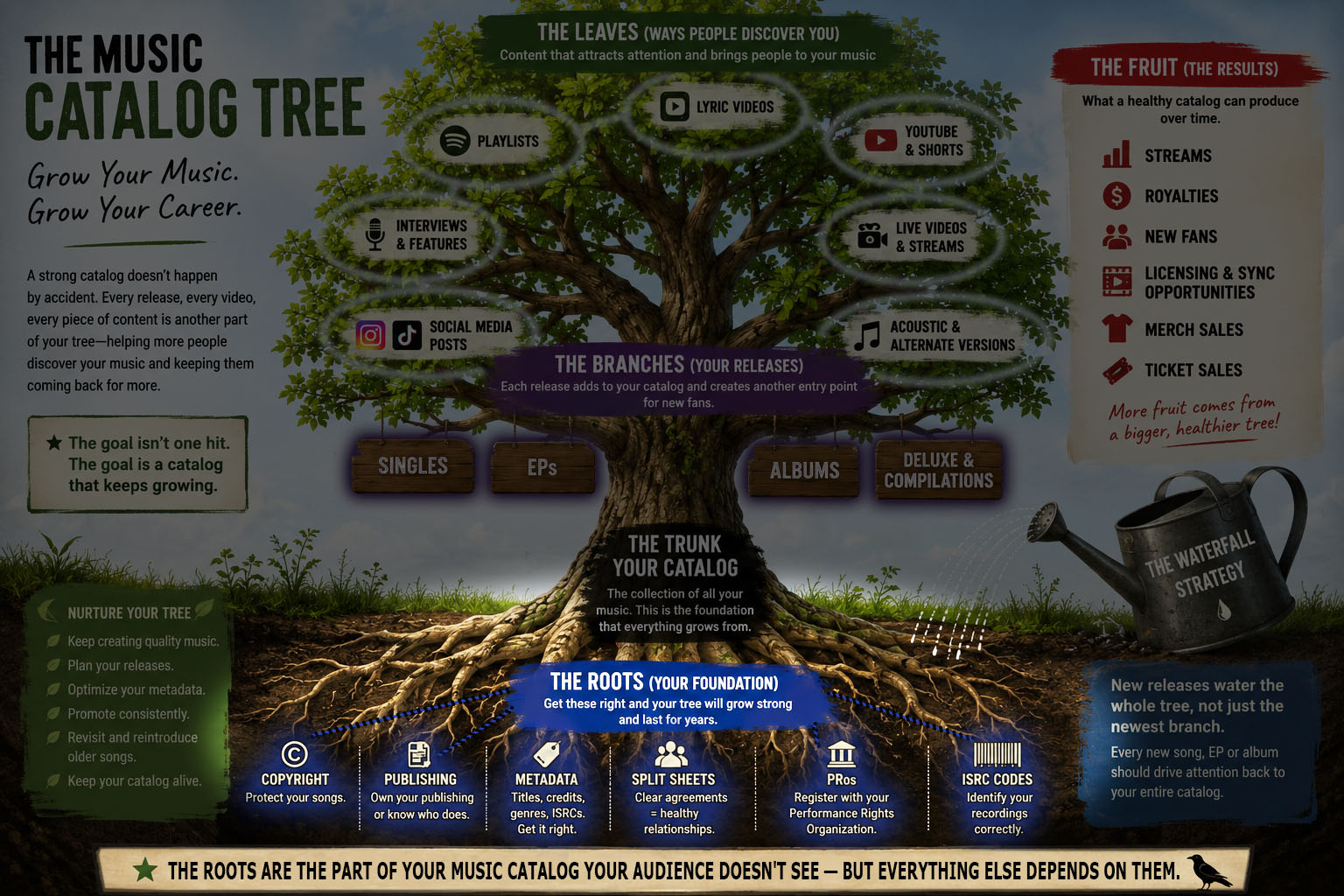
In Part 1, we looked at the whole music catalog as a tree. This time, we are going underneath to discover the roots. If you haven't read the introduction to the Music Catalog Tree yet, you can start with Part 1 here. How to build and manage your music catalog tree
👉The roots are the part nobody sees.
But without them, the tree doesn't stand for very long.
The same is true for your music catalog.
You can have great songs, beautiful artwork, a good release strategy and thousands of streams.
👉But if the information underneath your music isn't correct, problems can appear later.
And unfortunately, those problems often show up when money or rights are involved.
What Are the Roots of Your Music Catalog?
The roots are all the information and rights that sit underneath your music.
They include things like:
- Copyright
- Music publishing
- Songwriter information
- Split sheets
- Metadata
- ISRCs
- Registrations
- Agreements and contracts
Your listeners don't see most of this.
That's exactly why it's easy to ignore.
👉But these details help establish who created what, who owns what, and who should get paid.
Copyright — Who Created the Song?
Let's start with the most basic question:
👉Who owns the song?
Copyright exists as soon as an original work is created, but that doesn't mean you should stop there and forget about it.
If several people were involved in writing a song, you need to know exactly who contributed and what was agreed.
That's where things can get messy.
Maybe one person wrote the lyrics.
Someone else wrote the music.
A third person contributed to the arrangement.
Perhaps the band worked on the song together.
Who owns what?
Don't leave those questions until the song starts making money.
Split Sheets — Get the Agreement in Writing
A split sheet is simply a written agreement showing how the songwriting or publishing share of a song is divided between the writers.
It doesn't have to be complicated.
✅👉⚡The important thing is that everyone agrees before memories start disagreeing.
Because six months later, you may remember the writing session very differently from the person who was sitting next to you.
A simple written agreement can save a lot of arguments later.
And yes, even if everyone in the band is friends.
Especially then.
Music Publishing — Don't Confuse the Song With the Recording
This is one of the areas that causes independent musicians a lot of confusion.
A song and a recording of that song are not the same thing.
👉📢The composition is the underlying song — the music and lyrics.
📢👉The sound recording is the particular recording of that song.
They can have different rights, owners and income attached to them.
This distinction becomes important when you deal with publishing, performing rights, licensing, streaming and other uses of your music.
If you don't understand the difference, start there.
You don't need to become a copyright lawyer.
But you should understand what you actually own.
Metadata — The Information Attached to Your Music
Metadata is basically the information that travels with your music.
Depending on the situation, this can include things such as:
- Song title
- Artist name
- Songwriters
- Composer information
- Publisher information
- ISRC
- Release information
It may not sound very exciting.
It is also incredibly important.
Incorrect or incomplete metadata can make it harder to connect a recording with the right people and rights.
Think of metadata as the labels attached to the branches and fruit of your tree.
If the labels are wrong, things can end up in the wrong place.
ISRCs — Identifying the Recording
An ISRC is an identifier for a particular sound recording.
Think of it as an ID number for that recording.
It helps identify the specific recording as it moves through the music industry and digital services.
One important point:
👉📢An ISRC identifies a recording. It does not identify the underlying song.
✅That distinction matters.
A new recording of the same song can have a different ISRC because it is a different recording.
Registrations — Make Sure the Right People Know
Depending on where you are based and what you do with your music, you may need to register your songs and recordings with relevant organizations and services.
This can include performing rights organizations, collection societies, distributors and other rights organizations.
The exact process depends on your country, your role in the music and how the music is being exploited.
The important thing is not to assume that putting your music on a distributor automatically takes care of everything.
It doesn't necessarily.
📢⚡⚡Distribution is not the same thing as rights administration.
Keep Your Music Information in One Place
This is one of the simplest things you can do.
Create a catalog spreadsheet or database and keep your information organized.
For each song, you might record:
- Song title
- Writers
- Writer shares
- Publisher
- ISRC
- Recording date
- Release date
- Distributor
- Copyright information
- Registration information
- Links to the master recording
- Links to important documents
💡You don't need expensive software to start.
💡A well-organized spreadsheet can be incredibly useful.
✅The important thing is that you know where the information is.
Your Catalog Is Growing — So Are the Roots
Every new song adds another piece of information to your catalog.
Every new collaborator means another agreement to document.
Every new recording may need another identifier.
Every new release creates more metadata.
That's why it's worth building good habits early.
If you wait until you have 50 songs to organize everything, you're going to have a much bigger job on your hands.
Trust me.
Your future self will thank you.
The Roots You Don't See Can Still Cost You Money
This is the part I really want independent musicians to understand.
The boring administrative stuff isn't separate from your music career.
👉It is part of your music career.
If the wrong writer is listed, someone may not receive the money they're entitled to.
⚡If a split was never agreed, you may have a dispute later.
👉If metadata is wrong, a recording may not be correctly connected to the people or rights behind it.
If you don't know what you own, you may not know what you can license.
None of this makes for particularly exciting Instagram content.
But it can make a very big difference when your music starts generating money.
Don't Let the Roots Become an Afterthought
You don't need to have everything figured out before you release your first song.
But you do need to start building good habits.
For every new song, ask yourself:
Who wrote it?
Who owns what?
What was agreed?
Is the information written down?
Does the metadata match?
Has everything that needs to be registered been registered?
If you can answer those questions, you're already doing something many musicians don't do until they run into a problem.
And that brings us back to the tree.
You can't see the roots when you're looking at the tree.
But they're doing their job underneath everything else.
Your music catalog works the same way.
💥📢✅Take care of the roots, and everything else has something solid to grow from.
📢Coming Next: The Trunk
In Part 3, we'll look at the trunk — your music catalog itself.
Because your catalog isn't just a list of songs.
✅It's the body of work you're building over time.