
The Trunk: Why Your Music Catalog Is Your Long-Term Asset
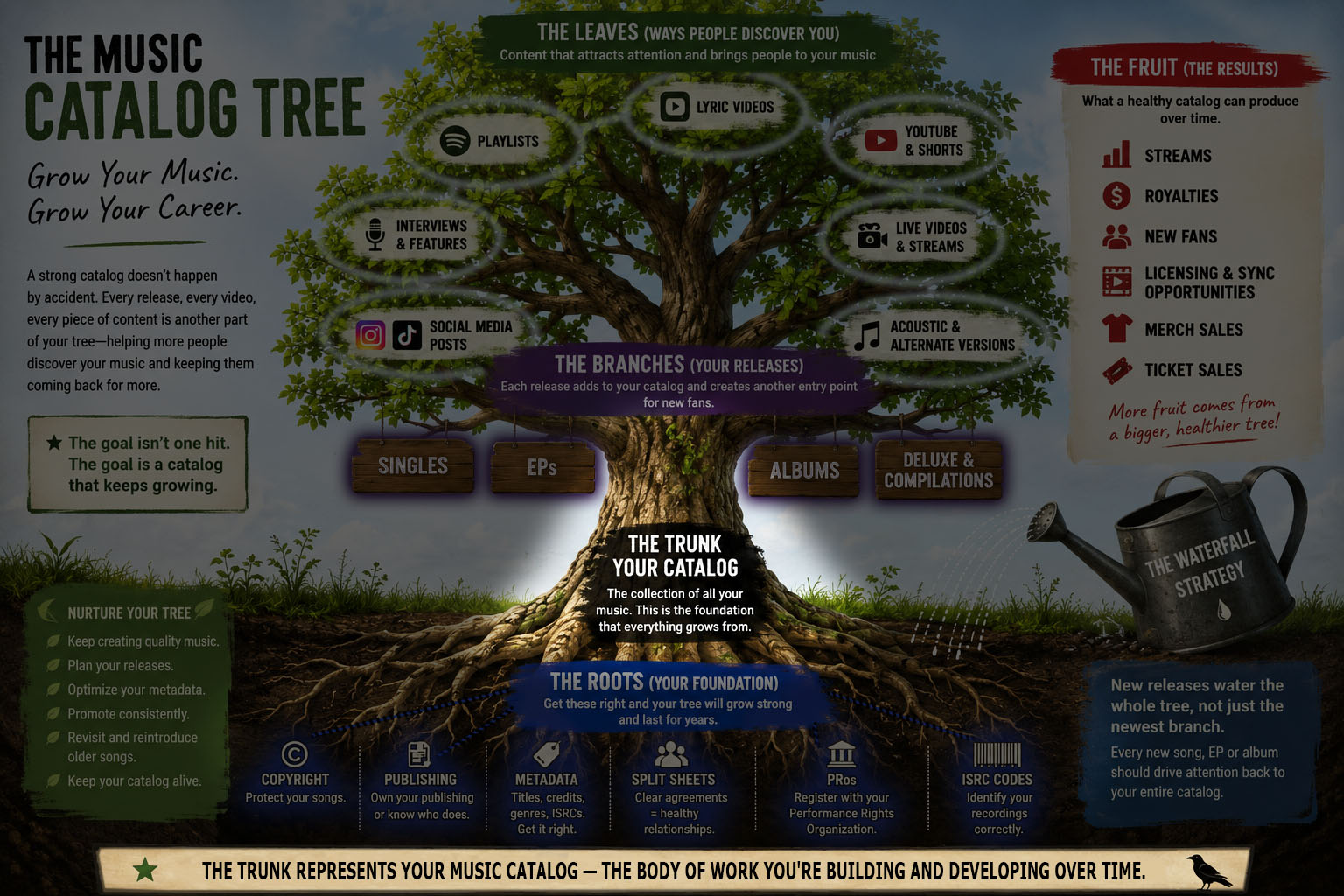
In Part 1, we looked at the whole Music Catalog Tree. In Part 2, we went underneath it to explore the roots — the foundation that supports everything else. If you missed that check these articles. Build and manage your music catalog, The roots building a strong foundation
Now it's time to look at the trunk.
🔨The trunk represents your music catalog: the body of work you're building over time.
When you're an independent artist, it's easy to focus on the next release. You write a song, record it, get it distributed, promote it, and then start thinking about the next one.
But what if you looked at your music differently?
👉Your songs aren't just individual releases. Together, they form a catalog that you can develop, manage and build on throughout your career.
And the more you understand how your catalog works, the more opportunities you may be able to create for yourself.
In simple terms, your music catalog is the body of music associated with you as a songwriter, recording artist or rights holder.
Depending on your role and the rights you control, it might include:
- Original songs you've written.
- Recordings you've released.
- Albums and EPs.
- Live recordings.
- Acoustic versions and remixes.
- Older releases that are still available.
- Songs you own or control the rights to, even if someone else performs them.
📢⚡It's important to remember that the song itself and the recording of that song are different things. You might own the songwriting rights but not the master recording, or you might control a recording without owning the underlying composition.
Your catalog can therefore include different types of work and different rights. Understanding what you own, what you control and what agreements apply is part of managing it properly.
You don't need a hundred songs to have a catalog.
You start building one with your first song.
Your Catalog Is More Than a List of Releases
Imagine you've released five singles over the last two years.
You might see them as five separate projects. Each had its own recording session, artwork, distribution date and promotional campaign.
But a listener who discovers one of those songs might want to hear more.
They might visit your artist profile, listen to another single, find an older EP, or discover a live version on YouTube.
Suddenly, those five releases aren't isolated projects anymore. They're connected parts of a bigger picture.
And that's where your catalog becomes interesting.
✅Every release gives people another possible way into your music.
The challenge is to make it easy for them to discover what else you have to offer.
Why Your Back Catalog Still Matters
The term back catalog usually refers to music released in the past.
It's easy to treat older songs as yesterday's news. You've moved on, you're excited about your latest release, and you want everyone else to be excited about it, too.
But your listeners don't all discover you in chronological order.
Someone might discover a song you released three years ago today. Another person might find your latest single and then work backwards through your releases.
An older song can still attract listeners, generate income where applicable, or lead to new opportunities.
Of course, not every release will keep attracting attention or earning money. Some songs may remain quiet for years.
But that doesn't automatically make them worthless.
Your back catalog gives you existing work to revisit, connect, promote and potentially develop in new ways.
Instead of always asking, "What should I release next?", it's also worth asking:
👉📢"What can I do with the music I've already released?"
Build on What You Have — Don't Always Start From Zero
One advantage of building a catalog is that you don't have to treat every new project as a completely fresh start.
You already have songs, recordings, artwork, videos and stories that can be used in future plans.
For example:
Make it easy for listeners to move from one song to another.
Use your artist profile, playlists, YouTube channel, website and social media to connect related music wherever the platforms allow it.
If someone enjoys your latest single, give them an obvious next step.
Revisit Older Songs
👉Could an older song work as an acoustic version, a live performance, a remix or a new video?
🛠️Not every song needs another version. But sometimes a different presentation gives an existing track a fresh reason to be heard.
Tell the Stories Behind Your Music
You might share how a song was written, what inspired the lyrics, or what happened during the recording session.
✅A song doesn't stop having a story when it's released. That story can help people connect with it long after launch day.
Depending on the music and the rights you control, your catalog might create opportunities for licensing, collaborations, sync placements, compilations or other projects.
✅None of these outcomes is guaranteed. But having your music organized and understanding your rights makes it easier to evaluate opportunities when they arise.
Independent Artists Have More Tools Than Ever
When I was studying the music business in 2017, I remember trying to fit all the different pieces together.
Publishing, distribution, promotion, rights, income streams — each subject seemed to have its own complicated world.
What I wanted was a clearer picture of how everything worked together.
Today, independent artists can access tools for digital distribution, audience analytics, direct-to-fan sales, video, social media and much more.
You don't necessarily need a traditional record deal to release your music, build an audience or develop a career.
But having access to these tools doesn't mean success is automatic.
💥✅You still need good music, persistence, realistic expectations and a willingness to learn. You also need to understand the business side of what you're doing.
📢The tools can help you take control. What you do with them is up to you.
And this is why I think catalog thinking matters so much for independent artists.
👉You're not just trying to make your next release work. You're building a body of work that can support your future projects, help new listeners discover you, and give you more options as your career develops.
Think of Your Catalog Like a Website
Here's another way to look at it.
Imagine you have a website with twenty useful articles.
One article attracts a lot of visitors. Another gets very little traffic. A third might sit quietly for months before suddenly becoming popular.
You wouldn't necessarily delete the older articles every time you publish something new.
Instead, you'd look for ways to connect the pages, improve the useful content and help visitors discover more of your site.
Your music catalog works in a similar way.
One song might bring someone to your music. Another might turn that casual listener into a fan.
You can't always predict which song will make the first connection.
But you can make it easier for people to explore what comes next.
📢One song can get someone's attention. A catalog can keep it.
Keep Your Catalog Organized
A growing catalog also needs some practical attention.
If you've followed Part 2, you've already started thinking about the roots: the information, rights and records that support your music.
Now think about the trunk itself.
Can you easily find all your releases? Do you know when they came out, where they're available and who was involved? Can you locate the relevant artwork, masters, videos and agreements?
A simple spreadsheet can help you keep track of:
- Song and release titles.
- Release dates and formats.
- Links to streaming platforms and videos.
- Songwriters and collaborators.
- Relevant ISRCs and registration details.
- Rights ownership and agreements.
- Artwork and master-file locations.
You don't need expensive catalog-management software to get started.
The goal is to know what you have, understand what you control, and be able to find the information when you need it.
As your catalog grows, good organization becomes increasingly valuable.
Your Catalog Is the Trunk — But the Tree Needs More
A strong trunk gives the tree structure. But a trunk by itself isn't the whole tree.
Your catalog needs branches: the releases and versions that grow from your existing work.
It needs leaves: the different ways people can discover your music.
It needs water: a release strategy that helps you nurture the catalog instead of constantly starting over.
And, of course, there's the fruit — the results your work may produce over time.
We'll explore each of these parts in the upcoming articles.
For now, remember this:
You don't need a huge catalog to start thinking long-term. You just need to recognize that every song you release becomes part of something bigger.
Don't treat your music as a series of projects that end when the next one begins.
👉Build your catalog. Look after it. And keep finding ways to help people discover what's already there.